
Low halogen epoxy resin 130 is a liquid bisphenol A grade at EEW 180-190 g/eq, sold in three chlorine tiers from 1,000 ppm to 300 ppm. Its 11,000-15,000 mPa·s viscosity at 25 °C, not the chlorine figure, caps how much filler a potting compound can carry. Filler loading sets the real chlorine budget.
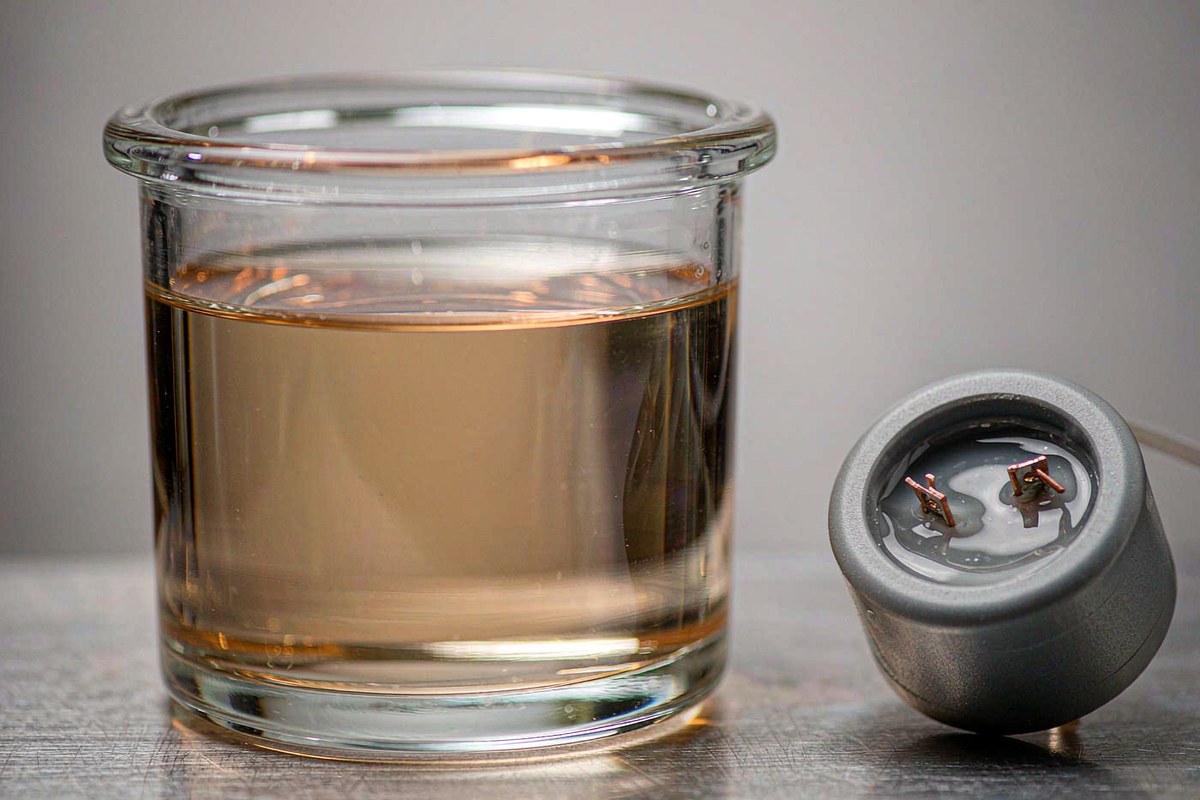
Figure 1. Low-chlorine resin beside a potted housing; Gardner 1 is the published colour limit on all three 130 grades.
Electronic potting runs on two specification lines that buyers merge. Chlorine sets ionic contamination; viscosity decides what the compound can be filled with.
The 130 series carries EEW 180-190 g/eq at 11,000-15,000 mPa·s, the rheology of an ordinary liquid bisphenol A resin, in the chlorine tiers of an electronic grade.
Values below are published Yolatech figures plus arithmetic on them. No castings were sectioned and no electrical tests were run.
Three grades form the series and differ only in chlorine. Table 1 reproduces the bisphenol A liquid resin page; no CAS number is printed there, so the grades are identified by EEW and tier.
Table 1. Published specification of the three 130 grades, from the bisphenol A liquid resin page and catalogue page 3.
Grade |
EEW, g/eq |
Viscosity at 25 °C, mPa·s |
Hydrolyzable Cl, ppm |
Total Cl, ppm |
Colour, Gardner |
Catalogue use |
YLE-130K |
180-190 |
11,000-15,000 |
300 |
1,000 |
1 max |
potting, adhesives, composite |
YLE-130L |
180-190 |
10,000-18,000 |
200 |
700 |
1 max |
potting, adhesives, composite |
YLE-130P |
180-190 |
10,000-20,000 |
100 |
300 |
1 max |
potting, adhesives, composite |
Colour is capped at Gardner 1 across the series; the catalogue records high purity and electronic grade.
EEW is determined by ASTM D1652 or ISO 3001 in the current TDS, viscosity measured at 25 °C by ASTM D445, colour by ASTM D1544, water by ASTM E203.
The two chlorine columns are different measurements. Hydrolyzable chloride is the ionic fraction released under the boiling test; total chlorine also counts what is bound into the backbone. The K, L and P suffixes follow total chlorine.
Viscosity is a range, not a mean of n = 3 determinations, so the midpoint is a target; filler ceilings in 3.2 are empirical starting points.
At the midpoint EEW of 185 g/eq, a kilogram of YLE-130K holds 5.41 epoxide equivalents; YLE-128K at 175 g/eq holds 5.88. That is 8.1% less reactive inventory per kilogram.
Heat released on cure tracks equivalents, not mass, so the 8% becomes a smaller adiabatic rise. Geometry still dominates: doubling a cylinder's diameter halves its surface-to-volume ratio.
Dosage follows: against YLH-3023 at AHEW 100 g/eq, phr falls from 58.8 at 170 g/eq to 54.1 at 185 g/eq.
Less hardener means a thicker mix.
YLH-3023 runs at 250-500 mPa·s, so trimming its share by 8% raises compound viscosity at both ends of the ratio.
Both families reach the same chlorine tiers, so tier and family are separate decisions. Table 2 compares the K grades.
Table 2. Low halogen epoxy resin 130 against the thinner 128 alternative, attribute by attribute.
Attribute |
YLE-130K (this product) |
YLE-128K (alternative) |
EEW, g/eq |
180-190 |
165-175 |
Viscosity at 25 °C, mPa·s |
11,000-15,000 |
3,500-5,500 |
Total Cl, ppm |
1,000 |
1,000 |
Hydrolyzable Cl, ppm |
300 |
300 |
Epoxide equivalents per kg at midpoint |
5.41 |
5.88 |
phr with YLH-3023, AHEW 100 |
54.1 |
58.8 |
Practical silica ceiling, % by mass |
55-60 |
65-70 |
Compound total Cl at 60% filler, ppm |
260 |
252 |
Compound total Cl at own ceiling, ppm |
273 at 58% filler |
202 at 68% filler |
At equal filler the 130 mix carries slightly more chlorine, 260 ppm against 252 ppm at 60%, because the smaller hardener charge dilutes the resin less.
The filler ceiling matters more. The ceiling depends on the resin: an 11,000-15,000 mPa·s grade usually stops accepting silica near 55-60% by mass, a 3,500-5,500 grade reaches 65-70%. At their own ceilings the casting holds 273 ppm against 202 ppm.
So the 130 series is the wrong answer to a pure chlorine question. It wins on a cooler thick section, on filler that stays suspended, and on Gardner 1 colour.
Hardener mass follows phr = 100 × AHEW ÷ EEW, computed on the measured EEW of the lot rather than the catalogue midpoint.
For 100 kg of YLE-130K at EEW 185 with YLH-3023 at AHEW 100, phr is 54.1, giving 54.1 kg of hardener, a 154.1 kg binder, and 385.3 kg of compound at 60% filler.
The YLH-3023 page lists PHR 52, normalised to EEW 190, as catalogue PHR columns typically are. Moving to YLH-3101 at AHEW 110 lifts phr to 59.5. On a lot that tests at 180, 52 phr sits 6.5% below the 55.6 phr the formula asks for, and a soft surface after 24 h follows.
Table 3. Total chlorine carried by a compound built on each 130 grade at 54.1 phr of YLH-3023.
Grade |
Resin total Cl, ppm |
Compound at 55% filler, ppm |
Compound at 65% filler, ppm |
Cl in a 5 kg casting, g |
YLE-130K |
1,000 |
292 |
227 |
1.14 |
YLE-130L |
700 |
204 |
159 |
0.79 |
YLE-130P |
300 |
88 |
68 |
0.34 |
A 5 kg casting at 65% filler holds 1.14 g of total chlorine on YLE-130K and 0.34 g on YLE-130P. That is the figure a customer's chloride limit applies to.
Warm the resin, not the hardener. Heating the amine shortens gel time far more than heating the resin shortens mixing.
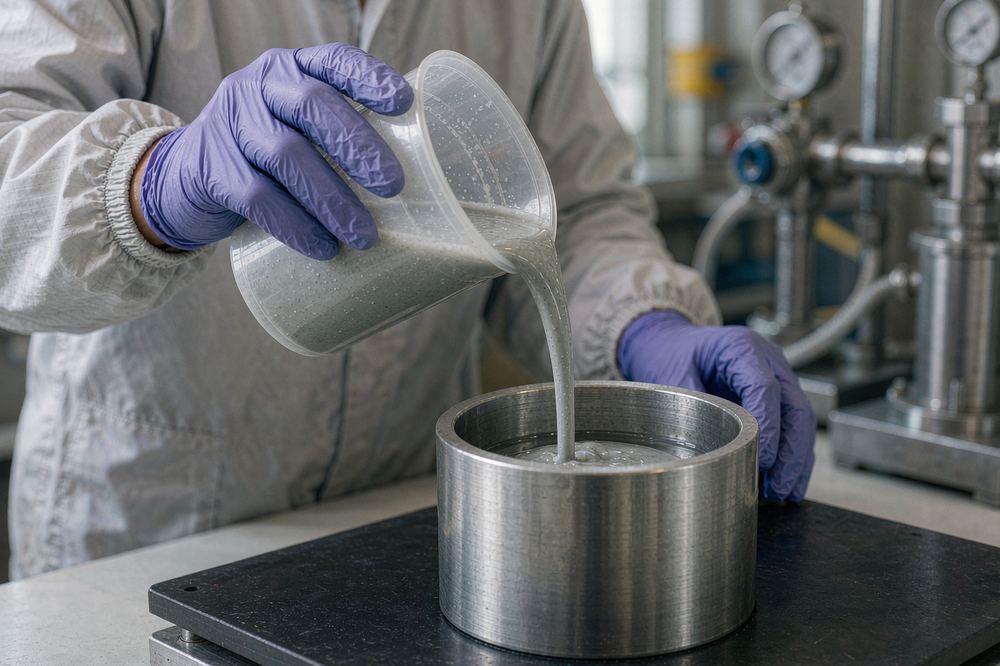
Figure 2. Filling a 2 kg mould through one gate; at 60% silica a 130 grade needs 40-45 °C to flow past the inserts.
Dosages below assume YLH-3023 at 54.1 phr on EEW 185 resin.
Function: hold inserts while silica stays suspended through a 300 mm fill. Dose: 55-60% silica at 54 phr, poured at 40 °C. Failure point: above about 2 kg the core exotherm outruns the mould wall and voids open around the insert.
Dose: none. Wetting 0.1 mm wire belongs to the 3,500-5,500 mPa·s grades. Function: complete fill without bridging. Failure point: at 11,000-15,000 mPa·s the compound bridges between windings, and partial discharge finds the voids later. A slower hardener such as YLH-6004 will not fix wetting.
Function: hold a bead on a vertical surface without bleed. Dose: 60-70% filler plus thixotrope at 54 phr. Failure point: excess thixotrope traps air against the substrate, and if a diluent thins it, that diluent enters the chlorine budget.
Failure point: line speed above the wet-out rate leaves dry strands. Function: keep a thick stack wet long enough to compact. Dose: 54 phr, bath at 40 °C; a 200 mm wet-out panel settles it.
Table 4. Four duties for the 130 series, with dose and the failure each one punishes.
Application |
Dose |
Function |
Failure point |
Sensor housings, 300 mm castings |
55-60% silica, 54 phr, 40 °C |
suspends filler, holds inserts |
core exotherm above 2 kg, voids at inserts |
Fine-wire coil encapsulation |
not recommended; use 128K at 58.8 phr |
wetting 0.1 mm wire |
bridging and voids between turns |
Gap-filling adhesive |
60-70% filler, 54 phr, thixotrope |
bead height, no bleed |
trapped air, chlorine from diluent |
Thick laminate, filament winding |
54 phr, bath at 40 °C |
wet-out time in a thick stack |
dry strands at high line speed |
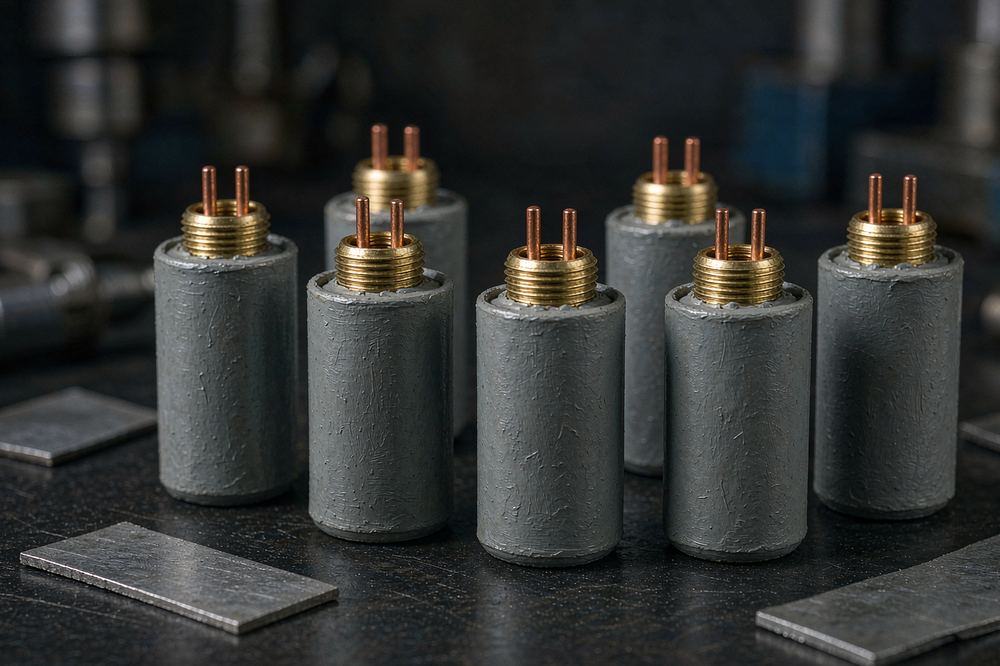
Figure 3. Potted housings after demoulding; the electrical test sees chlorine per part, not chlorine per resin kilogram.
No Tg, HDT, CTE or dielectric data is published, so none can be quoted; a UL 94 rating or IEC thermal class must come from the customer's own panels.
Total chlorine is a resin specification. It says nothing about the cured part, which also collects chlorine from hardener, diluent and filler.
Viscosity is published at 25 °C only, and the sources disagree on the K grade: catalogue 9,000-15,000 mPa·s against 11,000-15,000 on the page. The page value is used here.
In practice the grade is not a drop-in for a 128K/L/P tooling set. Different phr, different flow, 8% less exotherm per kilogram.
Verify EEW on every lot by ASTM D1652 or ISO 3001 and run the titration in duplicate; a 5 g/eq drift moves phr about 2.7% across the 180-190 band.
The resin page states at least 12 months in the original packing at ambient. Packaging for the 130 grades is not published, so confirm drum size and lining with sales.
Amine hardeners sensitise skin; gloves, eye protection and extraction are the baseline per the MSDS.
The number is a series label, not a property. All three sit at EEW 180-190 g/eq; the letter sets total chlorine at 1,000, 700 and 300 ppm.
No, and the gap runs about three to one. YLE-130K is capped at 1,000 ppm total and 300 ppm hydrolyzable; YLE-130P at 300 and 100 ppm.
Not without a new ratio. YLE-130P is roughly three times more viscous than YLE-128P, so a kit built for 68% silica will not flow at the old setting.
Because that PHR is normalised to EEW 190. At AHEW 100 the 180-190 band spans 55.6 down to 52.6 phr, about 5.7%. Weigh from the COA EEW of the drum in hand.
Partly. A 5 kg casting at 65% filler holds 1.14 g of total chlorine on YLE-130K and 0.34 g on YLE-130P, but a 6,000 ppm diluent at 5 phr lifts 300 ppm to about 571 ppm.
With limits. Its 5.41 eq/kg inventory releases about 8% less heat per kilogram, and 8% does not carry a 20 kg mass. Split the pour and measure the core peak.
Low halogen epoxy resin 130 is a rheology-first grade with electronic chlorine control, not a cheaper route to a lower-chlorine part.
Its 8.1% smaller equivalent inventory buys a cooler thick section. Its 11,000-15,000 mPa·s viscosity costs filler loading, and that shows as 273 ppm against 202 ppm in the finished casting.
Take the tier from the customer's chlorine limit, then the family from rheology and section thickness. Dosage is arithmetic: 54.1 phr at EEW 185, recomputed from every COA.
1. Yolatech product page: https://www.yolatech.com/bisphenol-a-epoxy-resin (accessed 2026-11-25)
2. Yolatech product page: https://www.yolatech.com/curing-agnet-ylh-3023 (accessed 2026-11-25)
3. Yolatech Catalogue 2026, page 3: https://www.yolatech.com/bisphenol-a-epoxy-resin
4. Yolatech Technical Data Sheet, Material Safety Data Sheet and Certificate of Analysis (COA) for YLE-130K, YLE-130L and YLE-130P, available on request.
5. ASTM D1652, epoxy content of epoxy resins (EEW)
6. ISO 3001, determination of epoxy equivalent
7. ASTM D445, kinematic viscosity
8. ASTM D1544, Gardner color of transparent liquids
9. ASTM E203, water content by Karl Fischer titration



 Поддерживается сеть IPv6