Waterborne Epoxy Hardener: The Cost Behind the VOC Label
Nov 27, 2026
Waterborne epoxy hardener is an amine adduct carried in water instead of solvent. Across the 14 YLH-W grades, AHEW spans 73-300 g/eq, so the hardener mass at a fixed 100 µm film moves from 32 to 70 g/m2. Dosing from the amine value instead under-doses by up to 82%. Water costs dwell time, not money.
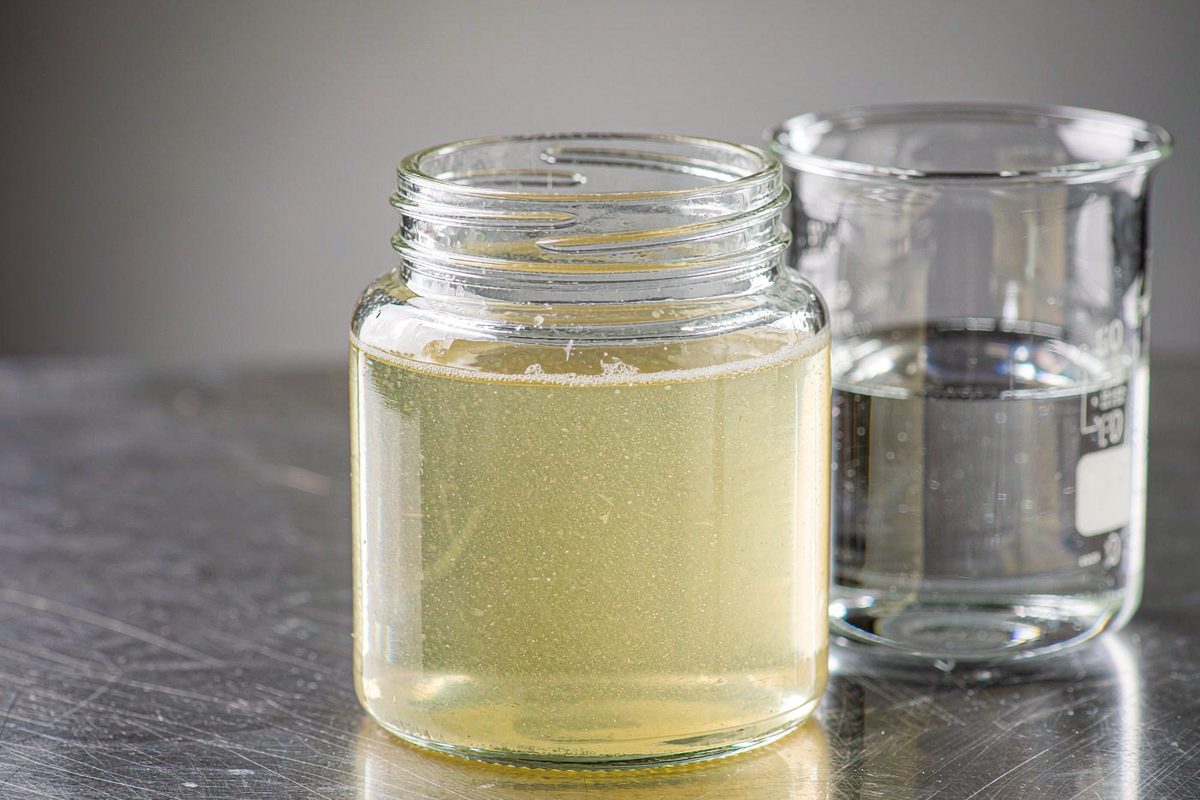
Figure 1. A waterborne amine hardener is a hazy liquid; the beaker beside it is the whole solvent load.
1. Introduction
Water is excluded from the VOC figure by definition, so a waterborne coating sells as low-VOC while still carrying an amine. The hardener is part of that package, and the part most often dosed from the wrong number.
Fourteen grades sit in the YLH-W range, from AHEW 73 g/eq to 300 g/eq. Every figure comes from the 2026 Yolatech catalog and its product pages.
2. Materials and Methods: What the Waterborne Epoxy Hardener Range Covers
The YLH-W series is a set of waterborne amine hardeners, supplied as aqueous adducts for two-pack systems where water is the only carrier.
2.1 Product identification and specification
Table 1 lists the range as printed on catalog page 14; AHEW spreads over a factor of four.
Table 1. Waterborne amine hardeners, YLH-W series, from the 2026 Yolatech catalog, page 14.
Grade
AHEW, g/eq
Amine value, mg KOH/g
Viscosity, mPa·s
phr
Pot life, min
YLH-1002W
284
150-190
8,000-12,000
145
60
YLH-1003W
300
150-190
25,000-45,000
140-180
60
YLH-1005W
120
250-300
6,000-13,000
60
60-120
YLH-1006W
151
185-225
12,000-25,000
77
90
YLH-1007W
73
380-420
80,000-150,000
35-40
120
YLH-1008W
240
150-180
100-400
125
70
YLH-1009W
145
200-230
23,000-31,000
75
30
YLH-1011W
145
250-280
3,500-5,500
70-80
40
YLH-1013W
150
240-280
5,000-10,000
77
35
YLH-1014W
170
200-250
500-1,300
87
60
YLH-1501W
285
100-200
5,000-20,000
115-120
not stated
YLH-2001W
300
140-180
8,000-15,000
150
not stated
YLH-2003W
96
300-360
1,000-1,500
50
65
YLH-3001W
150
280-320
8,000-25,000
75-80
not stated
No product page is live for these grades, so the catalog is the source; the resin side sits on the solid bisphenol A epoxy resin and liquid bisphenol A epoxy resin pages.
2.2 Test methods and data sources
The catalog does not name its methods. The figures correspond to: EEW according to ASTM D1652 or ISO 3001, amine value according to ISO 9702, viscosity measured at 25 °C by ASTM D445.
Pot life carries no test temperature or film thickness; an "18h" suffix on one aromatic grade of the same page fixes the default unit as minutes. Two entries need a note: YLH-1008W is printed at 400-100 mPa·s, read here as an inverted range, and YLH-1501W does not sit on the same phr basis. No duplicate runs are reported.
3. Results and Discussion: Amine Value, AHEW and Dosage
One number divides the fourteen grades: AHEW. It sets phr, and phr sets hardener mass per square metre.
3.1 Why the amine value cannot be converted into AHEW
If every amine group were primary, AHEW would follow 28,050 divided by the amine value. Nine grades break that relation, all in the same direction.
Table 2. Amine value converted to AHEW on an all-primary assumption, against the catalog AHEW.
Grade
Amine value, midpoint
AHEW if all primary
Catalog AHEW
Gap
YLH-1007W
400
70
73
+4%
YLH-1006W
205
137
151
+10%
YLH-2003W
330
85
96
+13%
YLH-1005W
275
102
120
+18%
YLH-1014W
225
125
170
+36%
YLH-1013W
260
108
150
+39%
YLH-1008W
165
170
240
+41%
YLH-1002W
170
165
284
+72%
YLH-1003W
170
165
300
+82%
The gap is the neutralised tertiary amine: the acid salt makes the adduct dispersible, that nitrogen titrates as amine value, and it never opens an oxirane ring.
Dosing from the amine value under-charges the system, by 4% on YLH-1007W and 82% on YLH-1003W. Ask for AHEW on the certificate, not the amine value.
3.2 Waterborne amine against a solvent-borne polyamide
The YLH-5022 polyamide is the reference solvent-borne option: 95% solids minimum, AHEW 165-185 g/eq, 30,000-80,000 cps at 25 °C, and xylene for viscosity.
Table 3. Waterborne amine YLH-1005W against the solvent-borne polyamide YLH-5022, at resin EEW 190.
Property
Waterborne amine YLH-1005W
Solvent-borne polyamide YLH-5022
Carrier
water
none, user adds xylene
AHEW, g/eq
120
165-185
phr at EEW 190
63
87-97
Viscosity at 25 °C
6,000-13,000 mPa·s
30,000-80,000 cps
Non-volatile, %
not published
95 minimum
Pot life
60-120 min
not published
Contribution to VOC
water excluded, acid counts
solvent is the VOC
Damp concrete
YLH-1003W is the damp grade
not recommended
Neither wins outright. The polyamide buys a wide application window and pays in solvent; the waterborne grade pays in dwell time.
4. Formulation and Dosage Calculation
Dosage follows one line: phr = 100 × AHEW ÷ EEW. At EEW 190, AHEW 120 gives 63 phr and AHEW 300 gives 158 phr.
Table 4. Hardener dosage and mass per square metre at 100 µm dry film, resin EEW 190, cured density 1.15 g/cm3.
AHEW, g/eq
phr
Binder, g/m2
Hardener mass, g/m2
73
38.4
115
31.9
120
63.2
115
44.5
240
126.3
115
64.2
300
157.9
115
70.3
That is a 2.2-fold spread in the second-most expensive component of the paint: about USD 0.15/m2 at an illustrative USD 4/kg.
Water adds a cost that never reaches the invoice. Removing 94 g/m2 of water takes 244 kJ/m2; 49 g/m2 of xylene takes 27 kJ/m2.
Table 5. Volatile removal at 100 µm dry film, model systems at 55% and 70% weight solids.
Item
Waterborne, 55% solids
Solvent-borne, 70% solids
Wet coating, g/m2
209
164
Volatile to remove, g/m2
94
49
Heat, kJ/kg
2,591
541
Heat, kJ/m2
244
27
Dwell at 1.5 kW/m2, s
163
18
Heat is cheap and dwell time is not: at a 1.5 kW/m2 flux the water film needs 163 s against 18 s, which is oven length, not a utility bill. On an air-drying line, the penalty is usually a longer recoat interval.
5. Processing Notes and Operating Window
Three settings decide whether a waterborne amine cures properly: induction time, humidity and wet film thickness. All three are shop variables.
• Induction: 5-10 minutes of standing after mixing lets the dispersion wet out and air escape. Skip it and the film typically shows pinholes.
• Humidity: above 85% RH the water cannot leave fast enough and the amine reacts with CO2 at the surface. White bloom follows within hours.
• Substrate: 10 °C minimum and 3 °C above the dew point. A cold slab pulls moisture from the air and the film never clarifies.
• Cure reading: the film clears as water leaves, but clearing is not cure. A 30-minute pot life turns a 20 kg kit into a 5 kg one.
Figure 2. The wet edge stays milky white and the cured strip behind it goes clear; judging dryness at the wet edge is how second coats get locked in.
6. Applications: Where Each Waterborne Epoxy Hardener Earns Its Place
Four application families account for most of the range, each leaning on a different property.
6.1 Concrete floors, including damp slabs
YLH-1003W is the grade listed for damp surfaces, at 140-180 phr and 60 minutes pot life; YLH-1008W is the non-ionic grade for penetration at 125 phr. Dosage sits high because the slab absorbs water and binder alike; a slab above the project moisture limit fails under any hardener.
6.2 Steel protection and shop primers
YLH-1005W is the non-sagging grade at 60 phr, YLH-1006W the hardness grade at 77 phr, YLH-1011W the impact grade at 70-80 phr. Flash rust on blasted steel is the failure point, and a damp shop closes the window.
6.3 Gloss topcoats for wood and architectural panels
YLH-1009W gives high gloss and fast drying at 75 phr with 30 minutes of pot life; YLH-1013W trades speed for chemical resistance at 77 phr. Batch size follows pot life, not convenience.
6.4 Adhesives and cementitious primers
YLH-2003W is the water-soluble grade at 96 g/eq and 50 phr; YLH-3001W brings flexibility and salt spray resistance at 75-80 phr. Porous substrates starve the bond line by absorbing water. The YLH-3023 cycloaliphatic amine is the solvent-borne comparator.
Table 6. Application map for the waterborne amine range.
Application
Grade
Dosage, phr
Function
Failure point
Concrete floor
YLH-1003W
140-180
adhesion on damp slab
rising moisture
Steel primer
YLH-1005W
60
non-sagging film
flash rust
Gloss topcoat
YLH-1009W
75
gloss and fast set
30 min pot life
Cementitious primer
YLH-3001W
75-80
flexibility, salt spray
absorption by substrate
Figure 3. A damp slab is workable and standing water is not; the wet edge in this photograph is the limit, not the target.
7. Limitations and Material Verification
Four gaps limit what this dataset can support.
7.1 Known limitations and out-of-scope cases
The range covers hardeners only. No waterborne epoxy dispersion is published, so the resin side comes from a solid grade such as the solution-type bisphenol A epoxy resin, and dispersing is a separate step.
Non-volatile content is not printed for any W grade, so VOC per litre cannot be computed from the catalog alone. Salt spray remarks on page 14 are qualitative, with no hours and no data.
YLH-1501W sits off-basis: its phr of 115-120 implies a resin EEW of 243 g/eq, while the other thirteen cluster at 187-200. The range is also wrong for neat casting.
7.2 Incoming inspection, packaging, storage and safety
Verify AHEW, water content and viscosity on each lot against the COA. A shift in water content moves the applied solids and the coverage, and viscosity alone will not reveal it.
Drums carry at least 12 months of shelf life in unopened packing at ambient temperature, and the material must be kept from frost. The amine is alkaline and attacks skin and eyes, so the MSDS governs; check every figure here against the current TDS and COA.
8. Frequently Asked Questions
What is the difference between AHEW and amine value in a waterborne epoxy hardener?
AHEW is the mass of hardener carrying one reactive hydrogen, so it drives dosage. Amine value counts every titratable group, including the neutralised nitrogen. The two differ by 4% to 82%.
How is phr calculated for a waterborne epoxy hardener?
phr = 100 × AHEW ÷ EEW of the resin as supplied. At EEW 190, AHEW 120 returns 63 phr. Recalculate when the resin lot changes: a 15 g/eq shift in EEW moves phr by 5%.
Can a waterborne epoxy hardener be applied to damp concrete?
YLH-1003W is the grade the catalog lists for damp surfaces. A damp slab is not a wet one: standing water and laitance defeat any hardener.
Why does a waterborne epoxy film stay milky or tacky?
Milky means water is still in the film, from a thick coat or high humidity. Tacky usually means under-dosing from the amine value, or a carbonate bloom from CO2 attack.
Does a waterborne epoxy system reach zero VOC?
Not by construction. Water is excluded from the VOC figure in most jurisdictions, but the neutralising acid and any co-solvent count. Check the local definition before a tender.
Can a standard polyamide hardener be used in a waterborne epoxy?
Not directly. YLH-5022 is 95% solids and needs solvent to reach application viscosity. A polyamide can be emulsified, but that is a separate step.
9. Conclusions
Fourteen waterborne amine hardeners span AHEW 73-300 g/eq and phr 35-180. At a fixed 100 µm film the hardener mass moves 32 to 70 g/m2, a 2.2-fold spread the VOC figure does not show.
Amine value cannot substitute for AHEW: the neutralised nitrogen inflates the titration and the derived phr under-doses by 4% to 82%. Water carries nine times the evaporation energy of xylene per square metre, but dwell time, not money, is what the line feels.
10. References
1. Yolatech 2026 product catalog, waterborne amine section, page 14; TDS for each grade on request.
2. Yolatech product page: https://www.yolatech.com/solid-bisphenol-a-epoxy-resin (accessed 2026-11-27).
3. Yolatech product page: https://www.yolatech.com/hardener-ylh-5022 (accessed 2026-11-27).
4. ASTM D1652, epoxy content of epoxy resins (EEW).
5. ISO 3001, determination of epoxy equivalent.
6. ISO 9702, amine group nitrogen content of amine epoxide hardeners.
7. ASTM D445, kinematic viscosity.
Читать далее






 Поддерживается сеть IPv6