Phenalkamine Epoxy Hardener: Cold Cure Without the Solvent Cut
Nov 18, 2026
Phenalkamine epoxy hardener is a Mannich-base curing agent built on cardanol, and the Yolatech catalogue lists 37 grades from AHEW 56 to 400 g/eq. YLH-9017 meets the NC-541 benchmark at AHEW 130 g/eq and 25,000-35,000 mPa·s, so cure runs down to 5 °C on damp steel and the pot lasts about 40 minutes.
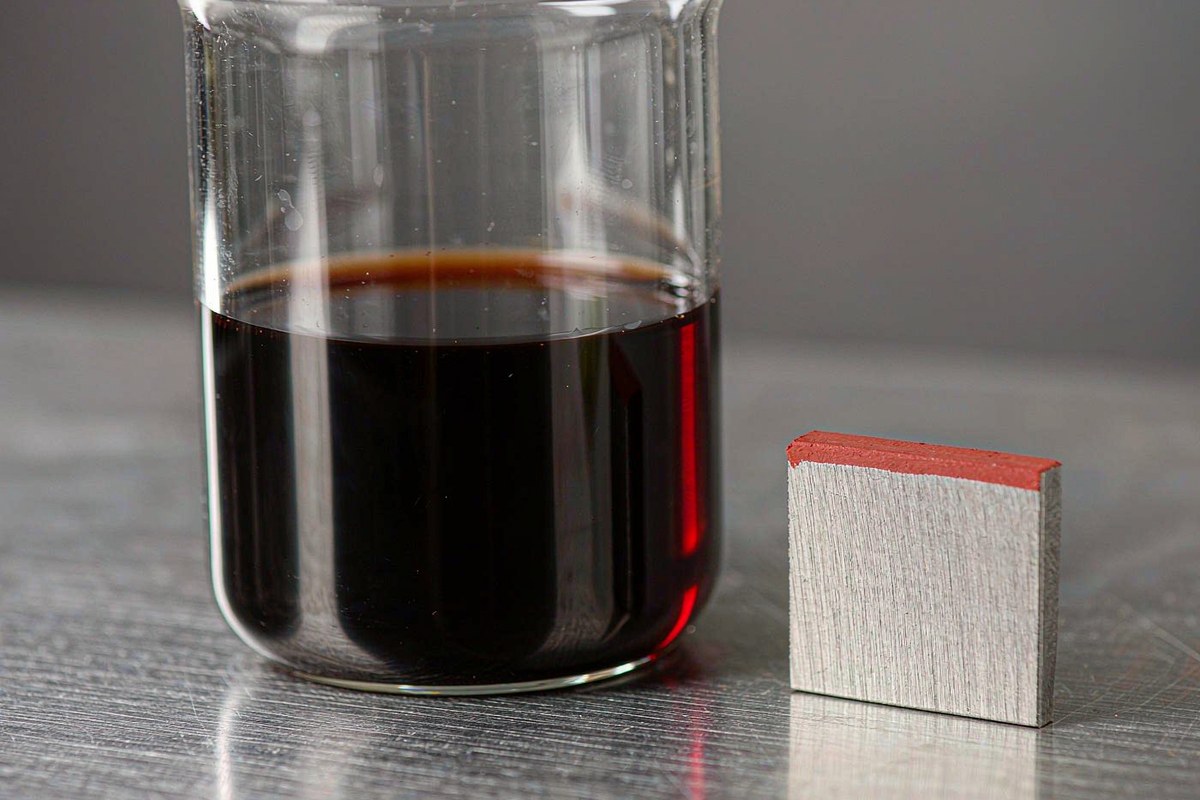
Figure 1. Phenalkamine hardener at Gardner 8 to 17, beside a steel coupon primed with red iron oxide.
1. Introduction
Epoxy primers lose their working window at both ends of the year. Below about 10 °C the amine–epoxide reaction slows sharply, and on damp concrete a polyamide film can blush before it hardens. Phenalkamines were built for that window.
The chemistry is a Mannich base of cardanol, formaldehyde and a polyamine on a phenolic ring. The C15 tail keeps viscosity low without solvent and makes the film hydrophobic. The benchmark supplier publishes dry-hard times at 25, 5 and 0 °C; the Yolatech catalogue gives fewer conditions. This report compares the one grade that lines up, YLH-9017, and marks the gaps.
2. Materials and Methods: Phenalkamine Epoxy Hardener Identification and Test Basis
All 37 grades sit on page 13 of the 2026 Yolatech catalogue under the YLH- prefix. Eight carry the analysis below, spanning 56 to 400 g/eq AHEW and 350 to 35,000 mPa·s.
2.1 Product Identification and Specification
Table 1 fixes grade identity and use; Table 2 the published numbers. No CAS number appears, so identity rests on grade name plus the COA.
Table 1. Identification of eight phenalkamine grades and the use each is catalogued for.
Grade
Catalogued use
YLH-9003
Flooring, heavy-duty
YLH-9012
Flooring, heavy-duty, protective
YLH-9017
Heavy-duty
YLH-9017X90
Heavy-duty
YLH-9021
Heavy-duty
YLH-9022
Flooring, protective
YLH-9051
Adhesives, heavy-duty, protective
YLH-9203
Heavy-duty
Table 2. Published specification of the same eight grades, with phr recalculated at EEW 190 g/eq.
Grade
AHEW, g/eq
Amine value, mg KOH/g
Viscosity at 25 °C, mPa·s
Color, Gardner
phr at EEW 190
Pot life, min
Set, h
YLH-9003
95
320–380
500–1,500
17
50.0
25
5
YLH-9012
95
290–350
350–650
10
50.0
20–40
5
YLH-9017
130
310–350
25,000–35,000
16
68.4
40
5
YLH-9017X90
144
280–320
3,000–5,000
16
75.8
40
3
YLH-9021
174
160–210
300–2,300
16
91.6
100
3
YLH-9022
62
540–580
500–2,000
8
32.6
30
3.5
YLH-9051
104
345–370
475–700
12
54.7
85
7
YLH-9203
400
110–150
1,000–3,000
14
210.5
60
1
2.2 Test Methods and Data Sources
Every figure in Table 2 comes from the catalogue; none was measured here. Viscosity is at 25 °C by spindle, color on the Gardner scale, AHEW per equivalent of amine hydrogen.
Two cross-checks ran. Each phr was recalculated as 100 × AHEW ÷ 190; 36 grades carry both figures, mean deviation 2.8%, maximum 15.9% at YLH-9055. AHEW was also checked against 56,100 ÷ amine value, which lands 18% below to 134% above it.
The second result is not an error: amine value titrates every basic nitrogen, including the tertiary amine that only catalyses cure, so it cannot be inverted into AHEW. EEW is determined according to ASTM D1652, amine value according to ISO 9702, color according to ASTM D1544. Where one figure is quoted, no standard deviation exists; in practice, expect ±5% between lots.
3. Results and Discussion: Cure Chemistry and Benchmark Position
3.1 Structure and Reactivity
A phenalkamine carries three reactive features on one molecule: the primary amine pairs with epoxy, while the phenolic hydroxyl and tertiary amine accelerate it. Hence a 40-minute pot beside a 5-hour thin-film set.
The cardanol tail explains the viscosity spread. Grades at 350–2,300 mPa·s act as reactive diluents; YLH-9213 reaches 40,000–80,000 mPa·s. YLH-9017 sits at 25,000–35,000 mPa·s, its X90 version at 3,000–5,000, so the pair covers the unheated and the sprayed case at AHEW 130 against 144.
3.2 Comparison with Alternative Systems
The obvious benchmark is NC-541, the grade most formulators name first. Table 3 sets YLH-9017 against it and against a polyamide, YLH-5101.
Table 3. YLH-9017 against the NC-541 benchmark and a polyamide alternative.
Property
YLH-9017
NC-541 benchmark
YLH-5101 polyamide
AHEW, g/eq
130
130
160–200
Amine value, mg KOH/g
310–350
330
200–240
Viscosity, mPa·s
25,000–35,000 at 25 °C
28,000 at 25 °C
50,000–80,000 at 40 °C
Color, Gardner
16
16
9–13
phr at EEW 190
68.4
68.4
84.2–105.3
Dry hard at 5 °C, h
Not published
15.5
Not published
Dry hard at 0 °C, h
Not published
23
Not published
On AHEW and viscosity the two are the same grade, so drum heating or a solvent cut still applies; what changes is who carries the cut. NC-541 splits into a 2,300 mPa·s LV and a 4,000 mPa·s X90, and YLH-9017X90 covers the second. In practice the LV case has no counterpart: YLH-9003 at 500–1,500 and YLH-9012 at 350–650 drop AHEW to 95, while YLH-3101 sits between at 110.
Color matches at Gardner 16, so both suit a pigmented primer, but neither suits a clear coat. Tinted work starts from YLH-9022 at Gardner 8; a near-white film needs a cycloaliphatic such as YLH-9101 at 2.
The solvent-borne versions pair off the same way, and that is where most substitutions go wrong. YLH-9017X90 carries AHEW 144 g/eq at 3,000–5,000 mPa·s against 144 at 4,000 for NC-541X90, so a line built around the X90 viscosity moves across without changing pump or tip. Table 4 lines them up.
Table 4. YLH-9017X90 against NC-541X90, the solvent-borne pair.
Property
YLH-9017X90
NC-541X90
AHEW, g/eq
144
144
Amine value, mg KOH/g
280–320
300
Viscosity at 25 °C, mPa·s
3,000–5,000
4,000
Solids, %
90, implied by suffix
90
Color, Gardner
16
16
phr at EEW 190, on solids
75.8
75.8
Dry hard at 5 °C, h
Not published
17
4. Formulation and Dosage Calculation
Dosage follows one line: phr = 100 × AHEW ÷ EEW. For 100 kg of liquid bisphenol A epoxy resin at EEW 187, YLH-9017 needs 69.5 phr, the figure NC-541 returns.
The hardener share is 40.6% of the mix at EEW 190. A low-viscosity grade doses lighter: YLH-9003 takes 50.8 phr at EEW 187, 18.7 kg less per 100 kg, leaving more room for filler.
Blends follow a harmonic rule: 70:30 of YLH-9003 and YLH-9021 gives 110 g/eq, not the 119 an average predicts.
Never back-calculate the dose from amine value. For YLH-9017, 56,100 ÷ 350 gives 160 g/eq, which would call for 84 phr against a real 68.4. A 23% overdose cures brittle and blushes in humid air.
Table 5. Calculated phr for six grades at three resin epoxy equivalent weights.
Grade
EEW 182, phr
EEW 190, phr
EEW 250, phr
YLH-9003
52.2
50.0
38.0
YLH-9012
52.2
50.0
38.0
YLH-9017
71.4
68.4
52.0
YLH-9021
95.6
91.6
69.6
YLH-9022
34.1
32.6
24.8
YLH-9051
57.1
54.7
41.6
5. Processing Notes and Operating Window
A 40-minute pot shapes the job on YLH-9017. Spread each batch inside about 25 minutes, and keep the next mix standing until the first is down.
Warm the resin, never the hardener. Heating the amine shortens pot life and drives free amine to the surface as a greasy film. Substrate temperature stays 3 °C above dew point, checked with a contact probe.
If the recoat window is missed, the carbonate layer blocks intercoat adhesion and sanding is the only recovery. Below 10 °C, set time runs past the 25 °C reference, so patch the floor first; a 24-hour delay at 5 °C is normal.
Figure 2. Floor coating applied by roller on damp concrete at 8 °C, the condition these grades target.
6. Applications
Table 6 maps grades to process steps; the constraint column decides. Cold-climate demand drives the line: India, the Middle East and Russia buy for the shoulder season.
Table 6. Process fit and the limiting constraint for each grade.
Grade
Process step
Limiting constraint
YLH-9003
Steel primer, damp plate
25-minute pot caps batch size
YLH-9012
Self-levelling floor
Gardner 10 limits tint depth
YLH-9017
Heavy-duty primer, cold site
25,000–35,000 mPa·s needs drum heat
YLH-9017X90
Sprayed primer
Solvent cut sets the VOC ceiling
YLH-9021
Tank lining
91.6 phr raises mixed viscosity
YLH-9022
Winter floor coat
30-minute pot, thick-section exotherm
YLH-9051
Structural adhesive
85-minute pot allows larger batches
YLH-9203
High-build primer
210.5 phr, exotherm risk
Figure 3. Rust bloom along weld seams on a primed tank shell, the surface a tolerant grade must hold.
7. Limitations and Material Verification
7.1 Known Limits and Non-applicable Cases
The catalogue publishes no dry-hard time at 5 °C or 0 °C for any of the 37 grades, while NC-541 publishes 15.5 h and 23 h and NC-541X90 17 h and 21 h. No parity claim is made.
Solids content is absent too, apart from the 90% implied by the X90 suffix; no grade is solvent-free until the TDS confirms it. No CAS number is published either, so identity is grade plus COA on the purchase order.
Two entries need correction before quoting: YLH-9031 is described as high-temperature curing with a high Tg, yet AHEW 56 g/eq and a one-hour set read as fast ambient; and the pot column carries text values such as 8h for YLH-9023 and 40mins for YLH-9009.
Color rules out light topcoats: Gardner 8 is the best, so a water-white coat is not a phenalkamine job. YLH-3002 at Gardner 1 covers that with different reactivity.
7.2 Incoming Inspection, Packaging, Storage and Safety
Titrate amine value on every incoming lot according to ISO 9702. A fall above 10% on the certificate points to moisture ingress or oxidation, and pot life moves with it.
Packaging and shelf life are not stated, so they belong in the supply agreement. Store sealed and dry; these amines darken with air and light, and colour drift is not a defect unless the lot feeds a tinted system.
These grades are alkaline and corrosive, and primary amines are skin sensitisers. Gloves, eye protection and ventilation are minimum controls; the SDS governs transport class. A RoHS or REACH statement applies only where a declaration covers the grade.
8. Frequently Asked Questions
What is a phenalkamine epoxy hardener?
A Mannich-base amine made by condensing cardanol, formaldehyde and a polyamine. The C15 chain lowers viscosity and raises water resistance; the amine groups crosslink the epoxy.
Is YLH-9017 a drop-in replacement for NC-541?
On paper, close enough to quote against: AHEW 130 g/eq on both, overlapping viscosity bands, Gardner 16 on both, 68.4 phr at EEW 190 on both. The 5 °C dry-hard figure and any food-contact approval do not transfer, so a patch stays on the critical path.
Can a phenalkamine cure epoxy below 5 °C?
The chemistry allows it, but the catalogue publishes no 0 °C dry-hard time for these grades. Below 10 °C, run a patch and time the set.
How much hardener goes into 100 g of resin?
Use phr = 100 × AHEW ÷ EEW. YLH-9017 at AHEW 130 g/eq takes 68.4 phr on an EEW 190 resin and 52.0 phr on an EEW 250 resin.
Is it approved for potable water or food contact?
Not by default. Some phenalkamines hold food-contact approvals, but none is published for these grades; approval depends on grade and jurisdiction.
Can it be applied to damp concrete?
Yes, within limits. The hydrophobic tail displaces a damp film, but standing water, active seepage and loose laitance still have to go first.
9. Conclusions
Across 37 grades spanning AHEW 56–400 g/eq, YLH-9017 is the like-for-like grade against NC-541: AHEW 130 g/eq on both, 25,000–35,000 mPa·s against 28,000, Gardner 16 on both, 68.4 phr at EEW 190 on both. YLH-9017X90 mirrors NC-541X90 the same way at 144.
Three gaps carry forward: 5 °C and 0 °C dry-hard data, solids content and grade-level CAS numbers. Until then the dosage table holds the technical case, and a site patch holds the cure claim.
10. References
1. Yolatech Catalogue 2026, page 13, phenalkamine grade table (YLH-9000 series); curing agent range at https://www.yolatech.com/curing-agent (accessed 2026-11-18).
2. Yolatech Technical Data Sheet and Certificate of Analysis (COA) for all eight grades in Table 2, available on request.
3. ASTM D1652, epoxy content of epoxy resins (EEW).
4. ISO 3001, determination of epoxy equivalent.
5. ISO 9702, amine group nitrogen content of amine epoxide hardeners.
6. ASTM D1544, Gardner color of transparent liquids.
Читать далее






 Поддерживается сеть IPv6